

There are two dance schools in town.
There is the older, more established school that creates ballerinas. My eldest granddaughter attended that school when she was four. They spent months perfecting the choreography. The costumes were expensive. The recital was held in a professional, state-of-the-art theater. Every hair was in place. The makeup was perfect.
And my granddaughter, who loved to dance, hated every minute of it.
She refused to go back.
Yesterday, I attended the first recital of my youngest granddaughter. She attends what I have come to think of as the School for Less Than Perfect Children.
One school teaches children how to dance. This one teaches them how to be themselves.
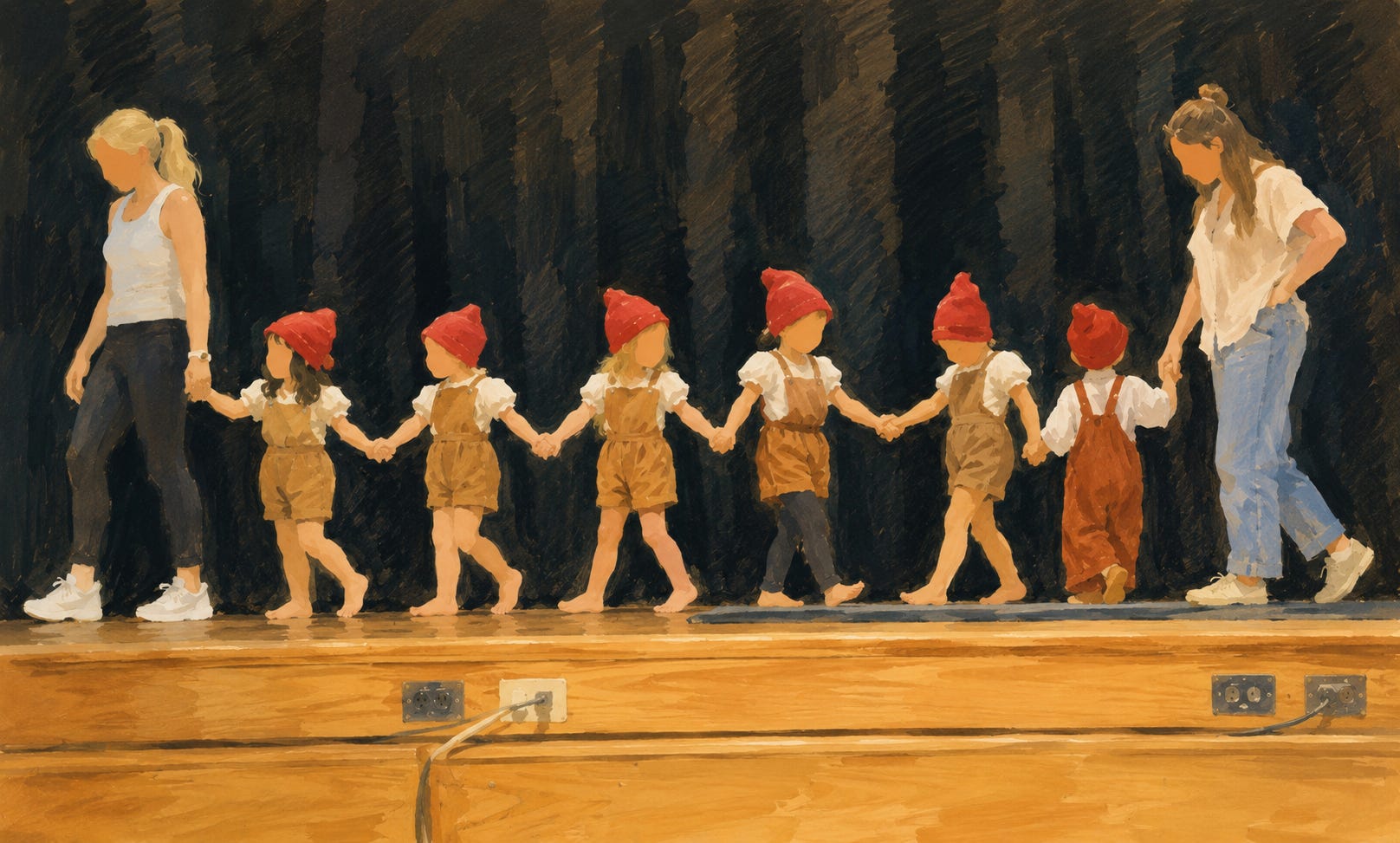
The recital was held in a high school auditorium that had seen better days. The costumes were a bit homegrown. The children were barefoot. Hair was slightly awry. Makeup was less than perfect.
As we stood in the rain, huddled under umbrellas, waiting for the doors to open, there was an air of expectant excitement in the crowd. My four-year-old granddaughter, normally shy and a bit timid, grabbed my hand and urged me to move faster when they finally let us in.
The house was packed with proud, expectant, slightly anxious parents and grandparents waiting for the show to begin.
For many families, mine included, this was the first time their young child would be stepping onto a stage alone, showing up in the world without a parent or grandparent holding their hand.
I imagine many of us were holding the same silent question: Will my child be okay?
The recital was divided into three shows by age, and this was the youngest group: one hundred fledglings, ages three to eight.
At the appointed hour, the owner of the dance school came on stage like a loving field commander of childhood – T-shirt, sweats, dressed not to impress, but to do the hard work of tending unpolished children.
She commanded the stage.
She told the packed crowd how proud she was of these children, how hard they had worked, how much progress they had made. Then she stopped, put one hand on her hip, wagged her finger at the audience, and sternly told us, “I expect you to clap like you mean it!” because these children deserved nothing less.
And then the first line of shy, awkward, mostly uncoordinated young children was led onto the stage.
Barefoot.
Uneven.
Uncoordinated.
Trying.
Forgetting.
Remembering.
Looking around.
Feeling brave.
Being seen.
Most of the children looked a bit wild-eyed as they stared out at an audience staring back at them. They were reminded where to stand. More than once, a wayward child was physically picked up and moved to the correct spot.
As each new piece of music began, the pattern was the same: a moment of hesitation, and then the familiar music took over.
Some children danced joyously.
Some hesitatingly.
Some shyly.
Some fearfully.
And some were so overwhelmed by the experience that they did not move at all.
But it was the little girl with dark pigtails and thick glasses who undid me.
She had Down syndrome. But there was no need to pretend we did not notice, because she was not asking to be noticed for that.
She knew all the steps. She danced with her whole body, joyously and freely, the stage belonging to her as much as to anyone else. She was happy to be there. She belonged. No asterisk. No apology. No diminished expectations. Just a child dancing. And when she had clearly had enough, she turned toward her mother in the front row and signed that she was done, even though the music had not yet stopped.
That was when my tears came.
I cry easily, so my tears did not surprise me. But then I looked at my daughter, and she was crying too. And when I turned to my husband and saw him blinking hard, trying to hold himself together, I understood that something important was being witnessed on that stage.
I cried as one group after another of children barely beyond toddlerhood came onto the stage.
There was the little girl so overwhelmed that she stood motionless in the middle of the stage, her fingers in her mouth, while her classmates danced around her.
There was the boy who could not do a somersault until his teacher came on stage and gently rolled him over — to thunderous applause.
There were the children who could not quite do cartwheels, but put their hands down and hopped instead, as the audience cheered them on.
There were the children who went left when everyone else went right.
There were the children who stopped mid-dance to admonish their classmates for doing the step wrong.
And there were the children who had no idea what came next and did not seem to care. They were just having fun.
At one point, I turned and looked at the audience.
Many were wiping away tears.
But…. Why were we crying?
On the surface, nothing “big” had happened.
No virtuosic performance.
No polished production.
No dramatic story.
No obvious tear-jerker.
Just a line of small, awkward, barefoot children walking onto a worn high school stage.
And yet the tears came.
We were witnessing innocence being protected rather than corrected. We were feeling the tenderness of children before the world had fully taught them to hide – children being invited into the full dignity of being seen.
And maybe we cried because something in the room bypassed the intellect and went straight to the heart: This is how it should be. When did that stop being true for me?
I cried for the raw beauty of what I was witnessing.
I cried for my older granddaughter, now eight, who loves to dance but hated being shaped into performance, and who is already measuring herself against her peers.
I cried for the child I once was.
I cried from the relief of seeing innocence not exploited, not polished, not compared — but welcomed.
In that auditorium, we were watching human beings at the beginning of becoming — still awkward, still exposed, still unhidden — stepping into visibility before they had learned to hide.
And when the room responded with real applause, the adults were not just clapping for a dance. They were affirming something much deeper:
We see you as you are.
You can be imperfect and still be celebrated.
You can belong before you are polished.
You can take your place before you are ready.
None of these children were pretending to be other than they were. And we cried because we knew, as adults, that pretending came with a cost.
The tears in that auditorium were communal, elicited by barefoot, unedited children who were not polished enough to protect us from feeling them. We remembered the beauty of such innocence, and the cost when it’s lost.
As adults, we have learned how to stand on the stage of life and appear composed. We have learned to say the right thing. Do the right thing. Meet expectations. Play the game. But perhaps, underneath, there still exists in each of us a frightened child, fingers in mouth, trying to self-soothe in a world that feels too much.
So why did we cry? We cried from the purity of innocence and the ache of knowing how temporary it can be.
But does it have to be that way?
Yes, innocence tends to be temporary.
Yes, the world teaches children to edit and hide.
But there are adults determined to delay that lesson.
And perhaps our task is to celebrate anyone willing to be seen.
So when you see someone brave enough, young enough, innocent enough, awkward enough, unpolished enough to stand before you as they are – clap like you mean it.
Because maybe, just maybe, if you clap like you mean it, others will learn there is no need to hide.
What a beautiful experience for everyone!
My autistic niece was in a dance class like that when she was about six years old.
It was beautiful 😭