

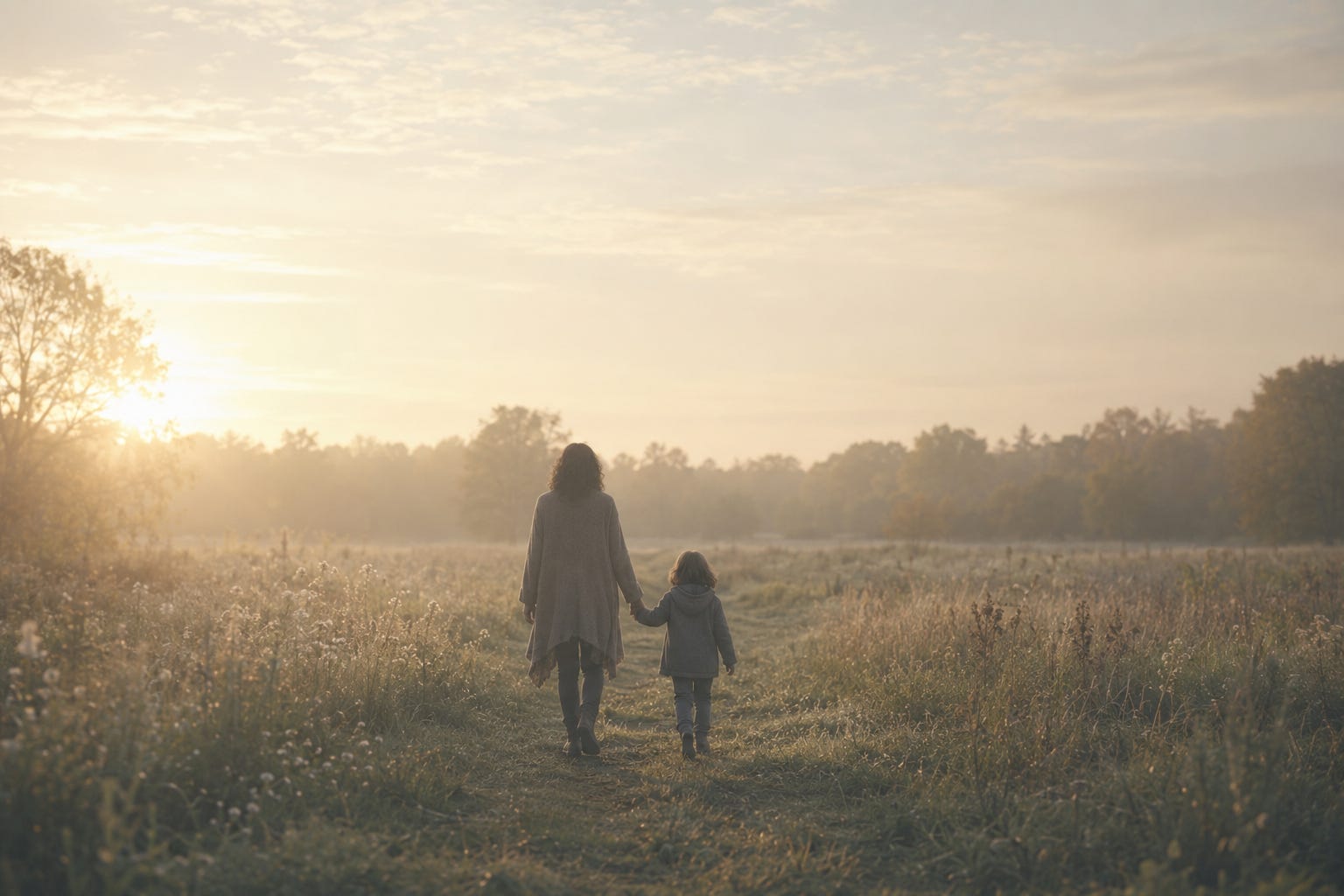
Can the child within my heart rise above?
Can I sail through the changing ocean tides?
Can I handle the seasons of my life?
But time makes you bolder
Even children get older
And I’m getting older, too.
~ Stevie Nicks
I do not remember what I had been accused of doing. I only remember the accusation and knowing within every part of me that it was absolutely not true.
A critical step-parent hurled words at me meant to diminish, then pushed me into my bedroom and slammed the door. I stood before the mirror with tears streaming down my face, my small hands clenched into furious fists at my sides. Powerless to defend myself to the person on the other side of the door, I stamped my foot and said to my reflection, over and over again, “I’m not that way! I’m not that way!”
No one heard me. No one came to defend me. No one came to reassure me. No one asked what had happened. But something inside me woke up that day and refused to surrender to another person’s judgment of who I was. I think I remember that incident so clearly, although it was one of countless others, because that was the night the frightened little girl began her journey toward claiming her own truth.
I spent my childhood living in the uncertainty of a swiftly negative response. I was always listening for the shift in tone, the angry footsteps, the accusations, the explosion – knowing that something negative would eventually arrive, but never knowing when, why, or what form it would take. My nervous system learned that waiting was not neutral. That the absence of conflict was not the same as being safe. Silence simply meant that danger was gathering and would eventually arrive.
But the seasons, they go ‘round and ‘round, and life has an uncanny way of showing us where we stand. Within the space of a single week, I received two unexpected messages from two people with whom I had shared long and meaningful relationships, and whose opinions and approval once carried considerable weight in my life. The circumstances surrounding each were entirely different, but the underlying experience was eerily familiar. Both had reached conclusions about me without first asking what was true. Once again, I found myself being told who I was by someone who had never stopped to inquire.
There was the unmistakable chill beneath the words that they sent, a tone that expressed displeasure and accusation, with the subtle embedded threat that warned me to be careful about displeasing them. For a woman whose childhood taught her that another person’s anger would bring unpredictable consequences, this was especially potent. Life had brought me back to familiar terrain twice in one week.
In the past I would have been devastated – believing I had done something wrong and needed to correct. In the past, I believed I was responsible for the emotional well-being of another, and that it was up to me to restore the balance. In the past, I would have felt the need to defend myself and prove I was not that. In the past, I would have stood in front of them pleading, “Please ask me. Please understand me. Please see that I am good.” But this time, to my surprise, my wound was no longer the first voice to respond.
I did not become defensive. I did not immediately begin searching myself for the hidden offense. I did not ask myself, “What did I do? How had I been misunderstood? How could I explain myself to restore balance?” Instead, I considered each message carefully, and allowed each to tell me a deeper story, a story about the senders, rather than a story about me, leading me to calculate whether the value of the relationship justified the cost.
For the first time in my life, another person’s displeasure did not feel like proof that I had done something wrong. I was proud of how calmly I responded to each sender, until my body reminded me that sending the message was not the part that I feared. What my body feared was the waiting for the response it knew would eventually come. Waiting was never empty in my childhood. Waiting was the time when danger picked up steam. Within the container of the same circumstances, I discovered how much I had healed, and how much I had not.
Upon receiving these messages I ran through many emotions -
Shock,
Anger,
Fear,
Grief,
Hurt,
Disappointment,
Sadness,
Choice,
Liberation.
These responses became the information needed to answer the question of “If this is how someone treats me, is that behavior welcome in my life?” Before, I would have explained, defended, corrected, restored, and earned the relationship back. This time, however, when I asked that question, the answer was, “No.”
But this is not a story about a conflict between me and others. This is a story about what happens when a woman who spent her childhood trying to prove her innocence finally stopped presenting her case. It’s a story about a woman who realizes that her identity is no longer contingent upon someone else’s assessment. And it’s also a story about the sadness that is felt when realizing that relationships are not always as they were understood to be.
Something radically different is unfolding. I no longer need to enter into another’s version of reality and defend my way out. That does not mean I am incapable of wrongdoing or beyond self-examination. But the change is that I am no longer assuming that another person’s displeasure with me proves there must be a hidden failure. I can consider the evidence honestly and conclude that the communication is the interpretation of another and their interpretation does not mean it is true. And then I can use that interpretation as information – not about my worth, but about the capacity of another to see me accurately and fairly, using that information to decide if the value of the relationship is worth carrying forward.
Through two seemingly unrelated interactions I realized that the harsh emotional tone of another doesn’t dictate the emotional tone of my response. Someone can be short with me, and I don’t have to become guarded. Someone can withdraw warmth, and I don’t need to chase it, or retaliate by withdrawing mine. Someone can communicate disapproval, and I don’t have to prove my worthiness, demand an explanation, or enter the emotional field they have created. I finally realized, through these interactions, that I have choice, and I can remain myself.
The sacred curriculum called Life is rarely easy. It asks us to feel what we once avoided, to recognize patterns we once chose to defend, to grieve what cannot be saved, and to choose ourselves without being bitter. The journey does not mean that the child within is so healed that she never appears again. It means recognizing that when the old wounds appear, we can say, “I am no longer that, and I can navigate the situation from who I have become, not as who I used to be.” The woman I have become can notice the frightened child and say, “I know you are afraid and I understand why. But that was then, and this is now. And now, you are no longer trapped. You are no longer powerless. And uncertainty is not the same thing as danger, even if your body remembers them as being the same.”
Healing is not always pretty or neat. Sometimes healing simply means allowing ourselves to mourn the beautiful things that could have been, while no longer volunteering to be diminished in order to have them.
The teaching in this story is not that I have become too strong to hurt. The greater teaching is that I can be hurt without abandoning myself. I can be judged without having to defend myself. I can understand the limitations of another without feeling an obligation to respond. I can remain tender, loving, and fully myself – and still walk away.
Healing is not a final destination. We move through life, and each season brings us into contact with something old, and the opportunity to bring to the old something new – a greater capacity, a broader perspective, and the tenderness and understanding that comes with maturity. And that tenderness belongs not only to the child who was hurt, but to the woman who has learned how to hold her. The landscape may seem familiar at times. But I am learning that the traveler has changed.
Healing is not the promise that the frightened child will never be frightened again, or that she will be able to rise above her fear. Healing is the discovery that when she is afraid – the woman I have become can reach down and take her hand.
Subscribe to The Art of Being Human
By Jude Smith
Essays, reflections, and meditations on living authentically and meeting life as a sacred curriculum.
I can relate to your words. I've experienced similar situations and am learning similar lessons. Keep writing. We need your words of wisdom.